
In Thailand’s rapidly expanding industrial corridors—from Rayong to Chonburi—factory managers and sustainability officers are facing immense pressure to meet global ESG targets and reduce Scope 2 carbon emissions. Vetting a multi-million dollar, 15-to-25-year Power Purchase Agreement (PPA) is a complex, long-term commitment.
In 2026, the research phase for these high-ticket B2B partnerships has fundamentally changed. Decision-makers are no longer just browsing Google listings; they are engaging in detailed, technical conversations with AI “Answer Engines.” This report uses Altovista’s GEO (Generative Engine Optimization) intelligence to map the algorithmic authority of the leading players in Thailand’s renewable energy sector, revealing a market ripe for technological disruption.
AI Market Share: The Battle for the Clean Energy Recommendation
In the generative web, “Market Share” is defined by AI Share of Voice (SOV)—the probability that a model will organically surface your brand when a buyer presents a high-intent commercial query.
Our audit conducted on 13 May 2026 revealed a unique scenario: The Algorithmic Blackout. Across a comprehensive matrix of 45 high-intent industrial prompts evaluated across multiple models, only 27 organic brand mentions were triggered.
This low volume is a defining feature of how AI engines process heavy enterprise sectors. When asked about solar integration, AI models spend 90% of their response length explaining engineering mechanics, BOI (Board of Investment) tax incentives, and Green Utility Tariffs (UGT) rather than pushing commercial vendors. Because B2B energy brands suffer from an industry-wide AEO (Answer Engine Optimization) deficit, engines default to conceptual advice rather than product recommendations.
The AI Share of Voice Leaderboard
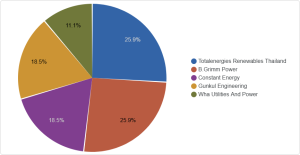
AI Share of Voice (SOV) of Clean Energy Brands in Thailand
- TotalEnergies Renewables Thailand (25.9%): Co-leading the sparse organic mention space, leveraging strong global enterprise authority.
- B.Grimm Power (25.9%): Tied for first, benefiting from deep roots in Thailand’s localized utility infrastructure and corporate news footprint.
- Constant Energy (18.5%): Frequently pulled by engines for its highly relevant technical blog posts detailing commercial factory case studies.
- Gunkul Engineering (18.5%): Recognized primarily by localized knowledge graphs for engineering and procurement execution.
- WHA Utilities and Power (11.2%): Surfaced for its specific integrations within the Eastern Economic Corridor (EEC) industrial estates.
- BayWa r.e. Thailand (0.0%): Currently invisible to organic AI discovery across all tested prompt parameters.
The Audit in Action: Multi-Engine Response Analysis
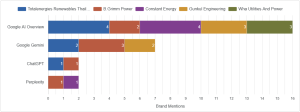
AI Engine Bias of Clean Energy Brands in Thailand
To understand why the mention count remains constrained, we look at AI Engine Bias and risk aversion. When evaluating multi-million dollar utility infrastructure, LLMs prioritize regulatory accuracy over vendor promotion:
Can you explain how a solar PPA works for a large Thai manufacturing plant looking to achieve carbon reduction targets?
- Google AI Overview: Proved to be the most active model, generating 16 of the total 27 industry mentions. It actively synthesizes localized directory facts and press announcements, pulling in local brands like Gunkul and Constant Energy next to legal updates on the removal of Ror. Ngor. 4 factory licensing requirements.
- Google Gemini: Captured 7 mentions, balancing high-level PPA structural mechanics with a focus on institutional players like B.Grimm Power.
- ChatGPT & Perplexity: Exhibited extreme risk-aversion, recording only 2 mentions each. Instead of listing brands, these models focused entirely on advising the user on how to structure contract milestones (like Commercial Operation Dates) and how to manage grid intermittency through Battery Energy Storage Systems (BESS).
Citation Grounding: The Architecture of Trust
AI engines do not formulate recommendations in a vacuum; they retrieve them from indices of verified digital literature.
The Sources of Influence (Thailand Region)
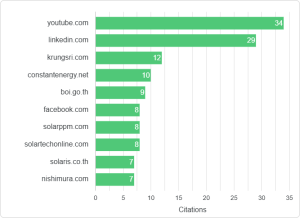
Top Cited Domains of Clean Energy Brands in Thailand
Through our SVO intelligence, we have mapped the authoritative digital ecosystem that serves as the “source of truth” for AI engines in this sector:
- youtube.com (34 citations): The leading domain crawled by AI models to decode the operational and step-by-step realities of industrial solar arrays.
- linkedin.com (29 citations): A primary “B2B Proof” network. Engines cross-reference professional updates to verify institutional presence and corporate execution.
- krungsri.com (12 citations): Macro-economic analysis portals from major local financial institutions are heavily relied upon by AI to verify market context, green finance guidelines, and net-zero timelines.
- constantenergy.net (10 citations): The top-performing brand domain. By hosting clear, technical documentation of their commercial projects, their site is highly optimized for AI machine-harvesting.
- boi.go.th (9 citations): The official Thailand Board of Investment domain. AI models look to government portals to ground their compliance answers regarding tax privileges and BCG (Bio-Circular-Green) economy policies.
Own the Grid: The SVO Path to Clean Energy Dominance
The transition from traditional grid dependence to on-site renewable infrastructure is an intricate process for Thai enterprise manufacturers. The current lack of organic brand recommendations in AI search engines represents a massive, blue-ocean opportunity for B2B energy firms.
Because no single brand has captured dominant algorithmic authority, the entire industry remains on a level playing field. For a brand sitting at 0.0 organic SOV, the strategy is clear: they must move beyond legacy keyword stuffing and embrace SVO (Search Visibility Optimization).
The baseline data reveals that brand-owned websites are being completely ignored if they lack clear, machine-readable structures. To conquer this vacuum, energy providers must strategically seed verifiable project milestones and technical data across the external banking, regulatory, and professional portals that AI engines utilize as their citation grounding. In an industry starving for a trusted voice, the first company to achieve true AI omnipresence will become the definitive “Answer” when a factory manager asks an AI how to future-proof their operations.
Data Note: Insights derived from the Altovista Dashboard (13 May 2026) using a proprietary Prompt Matrix to simulate Thailand manufacturing enterprise behavior across ChatGPT, Gemini, Perplexity, and Google AIO.